Quantum Science Generation | QSG 2026

→ Europe/Rome
Aula Renzo Leonardi (ECT*)

Aula Renzo Leonardi

ECT*

Strada delle Tabarelle 286, I-38123 Villazzano (Trento)
Alessio Baldazzi, Alex Windey, Chiara Capecci, David Pascual Solis, Federica Mantegazzini (Fondazione Bruno Kessler), Matteo Wauters
Description


Quantum science and computing are advancing at an unprecedented pace, driven by rapid progress in hardware and theory, and are becoming central to modern science and technology. At the same time, quantum information has emerged as a deeply interdisciplinary field, bridging condensed matter, molecular physics, quantum optics, and high-energy physics. In this timely context, the fourth edition of Quantum Science Generation (QSG) 2026 provides a focused training and exchange platform for young researchers entering or expanding their expertise in quantum technologies. The workshop features in-depth modules on advanced topics in quantum computation alongside state-of-the-art overviews of leading quantum computing platforms, complemented by contributed talks and discussions. By bringing together established experts and early-career researchers, QSG 2026 fosters cross-disciplinary dialogue, collaboration, and new insights that are crucial for advancing the rapidly evolving field of quantum computing.

The event is aimed at graduate students and junior researchers who wish to deepen their expertise or enter the field of quantum technologies for the first time, by featuring a combination of dedicated lectures and topical seminars. 

  • Advanced lectures on different pathways to fault-tolerant quantum computing:
    • Quantum information with continuous variables: from quantum computing to bosonic error-correcting codes
    • Measurement-based quantum computing: universality, foundations and fault-tolerance
    • The tumultuous road from NISQ to FTQC; error mitigation, error correction, and algorithms
  • Topical seminars on the state of the art of leading quantum computing platforms: 
    • Neutral atoms
    • Trapped ions
    • Photonics
    • Superconducting circuits


Lecturers:

  • Giulia Ferrini (Chalmers University of Technology, Sweden)
  • Robert Raussendorf (Leibniz University Hannover, Germany)
  • Xavier Bonet-Monroig (Honda Research Institute Europe GmbH)

Invited speakers: 

  • Marcus Huber (Technical University Vienna & Institute of Quantum Optics and Quantum Information, Austria)
  • Martin Ringbauer (University of Innsbruck, Austria)
  • Florian Meinert (University of Stuttgart, Germany)
  • Stefano Paesani (Niels Bohr Institute, Denmark)
  • Giovanna Tancredi (Chalmers University of Technology, Sweden)
  • Yun Li (American Physical Society, USA)


WARNING: for hotel bookings do not give your data to any external services upon email request; there are known cases of fraud.


Conference fee:

  • Early bird: €205 - register before 15/03/2026
  • Regular: €250 - registration deadline 12/04/2026


The conference fee  includes lunches, coffee breaks, social dinner, and aperitifs during the poster sessions. After registering for the event on this website, you will be provided with a link to the UniTN payment platform to complete your registration.


Supporting projects and institutions


Sponsors


Social Activities Support

Registration
ECT* workshop registration - QSG 2026
Participants
    • Welcome and registration: welcome and registration Aula Renzo Leonardi

      Aula Renzo Leonardi

      ECT*

      Strada delle Tabarelle 286, I-38123 Villazzano (Trento)
    • Keynote Speaker: Marcus Huber Aula Renzo Leonardi

      Aula Renzo Leonardi

      ECT*

      Strada delle Tabarelle 286, I-38123 Villazzano (Trento)
    • 11:00 AM
      Coffee break Aula Renzo Leonardi

      Aula Renzo Leonardi

      ECT*

      Strada delle Tabarelle 286, I-38123 Villazzano (Trento)
    • Lecture: Xavier Bonet-Monroig Aula Renzo Leonardi

      Aula Renzo Leonardi

      ECT*

      Strada delle Tabarelle 286, I-38123 Villazzano (Trento)
    • 1:00 PM
      Lunch break Aula Renzo Leonardi

      Aula Renzo Leonardi

      ECT*

      Strada delle Tabarelle 286, I-38123 Villazzano (Trento)
    • Contributed talk Aula Renzo Leonardi

      Aula Renzo Leonardi

      ECT*

      Strada delle Tabarelle 286, I-38123 Villazzano (Trento)
      • 1
        Comparing and learning figures of merit for quantum circuit compilation.

        Different quantum hardware of the current NISQ generation have a different basis set of quantum operations and a limited connectivity among different qubits, which requires the execution of a general quantum circuit to undergo a lot of pre-processing. Quantum circuit compilation is the process of making quantum circuits executable on a particular quantum device. This usually involves multiple steps, including qubit mappings, routings, gate synthesis, and circuit optimization. Different compilation methods have been devised that generate the 'best-version' of an executable quantum circuit, which is generally quantised by a figure of merit. These figures of merit, for example, the number of two-qubit gates, circuit runtime, expected fidelity, or, more recently used, the predicted Hellinger distance, and probability of successful trials (PST), are expected to evaluate the quality of quantum circuits. However, it is still unclear which figures of merit are indicative of a superior quantum circuit quality. In this work, we investigate the performance, quality, and shortcomings of the different figures of merit. Based on these results, we proposed a figure of merit (a weighted version of the probability of successful trials), and designed a two-step machine learning model that can predict the aforementioned figure of merit by taking into account both the quantum circuit and quantum hardware data. The first step involves predicting the additional quantum resources required for the given quantum circuit, provided the coupling map of the available quantum hardware. The second step then uses that to predict the weighted PST, now taking into consideration the coherence times data from the quantum device.

        Speaker: Harshdeep Singh (Chalmers University of Technology)
      • 2
        Several orders of magnitude sampling overhead reduction in quantum error mitigation

        Quantum error mitigation (QEM) infers noiseless expectation values by combining outcomes from intentionally modified, noisy variants of a target quantum circuit. Unlike quantum error correction, QEM requires no additional hardware resources and is therefore routinely employed in experiments on contemporary quantum processors. A central limitation of QEM is its substantial sampling overhead, which necessitates long execution times during which device noise may drift, potentially compromising the reliability of standard mitigation protocols. QEM strategies based on agnostic noise amplification (ANA) are intrinsically resilient to such noise variations, but their sampling cost (runtime overhead) remains a major practical bottleneck. In this work, we introduce the virtual noise scaling framework which reduces the sampling overhead by three to five orders of magnitude. As a result, mitigation tasks that once seemed unrealistic (even for the future) are now challenging but achievable. The proposed approach is compatible with dynamic circuits and can be seamlessly integrated with error detection and quantum error correction schemes. In addition, it is applicable to ANA-based mitigation of mid-circuit measurements and preparation errors. Our findings extend to any constant-step amplification factors and therefore also apply to probabilistic error amplification (PEA) QEM. We validate our post-processing approach by applying it to previously reported experimental data, where we observe a substantial improvement in mitigation efficiency and accuracy.

        Speaker: Raam Uzdin (Hebrew University of Jerusalem)
      • 3
        k-interaction angle quantum approximate optimization algorithm

        he quantum approximate optimization algorithm (QAOA) has emerged as a promising candidate for demonstrating quantum advantage on noisy intermediate-scale quantum (NISQ) devices. While various QAOA parameterization schemes exist, ranging from the original single-angle approach to the more expressive multi-angle quantum approximate optimization algorithm (MA-QAOA) and automorphic-angle quantum approximate optimization algorithm (AA-QAOA), each presents distinct trade-offs between expressiveness and classical optimization complexity. In this work, we introduce the k-interaction-angle quantum approximate optimization algorithm (kA-QAOA), a parameterization scheme that groups cost function terms by their k-body interaction order, providing a natural middle ground between parameter efficiency and solution quality. This approach is particularly well-suited for combinatorial optimization problems defined on hypergraphs, where multi-body interactions naturally arise in applications such as Boolean satisfiability and resource allocation with multi-party constraints. We benchmark kA-QAOA against standard QAOA, MA-QAOA, and AA-QAOA on two problem classes: 3-uniform cyclic sign-alternating hypergraphs and random coefficient hypergraphs. Our results demonstrate that kA-QAOA achieves approximation ratios comparable to MA-QAOA while requiring significantly fewer function evaluations, thereby reducing quantum resource consumption. Additionally, we investigate the role of quantum magic as a computational resource in these algorithms, examining how magic accumulates across different parameterization schemes and its relationship to optimization performance.

        Speaker: Mirko Consiglio (University of Malta)
    • 4:00 PM
      Welcome presentation by the ECT* Director, Ubirajara van Kolck Aula Renzo Leonardi

      Aula Renzo Leonardi

      ECT*

      Strada delle Tabarelle 286, I-38123 Villazzano (Trento)
    • Poster session & Brunch Aula Renzo Leonardi

      Aula Renzo Leonardi

      ECT*

      Strada delle Tabarelle 286, I-38123 Villazzano (Trento)
      • 4
        Quantum/classical correspondence, entanglement and phase transition in 1+1D $\phi^4$ interacting scalar Lifshitz field theory

        We propose a 2D/1D quantum/classical correspondence between a 1+1D $\phi^4$ interacting renormalizable scalar quantum field theory with Lifshitz scaling (LFT) and a 1D nonunitary $\mathcal{PT}$ symmetric Euclidean classical theory by developing a Rokhsar-Kivelson family of Lifshitz groundstates. We construct the kernel propagators of our chosen Lifshitz field theory by solving the equivalent classical field equation via both nonperturbative and perturbative approaches. We study the groundstate and the first excited state energies of the interacting LFT as the functions of the coupling $\Lambda$ for any fixed value of the anisotropy index of the Lifshitz scaling. We will show that the quantum states of the interacting LFT will acquire both real and imaginary energy eigenvalues for any finite coupling. Hence such quantum theory is entirely in non-$\mathcal{PT}$ symmetric phase. We further implement the kernels derived via both nonperturbative and perturbative techniques in the famous replica principle to analyze the entanglement entropy of a single finite subsystem in such Lifshitz theory. We identify a distinct phase transition-like scenario while varying the entanglement entropy with the interaction strength. In connection to this, we comment on the possibility of emergent exotic quantum phases in self-interacting scalar LFT.

        Speaker: Adrita Chakraborty (AGH University of Science and Technology)
      • 5
        Extrinsic Topology and Noisy Dynamics of Discrete-Time Quantum Walks in Photonic Lattices

        Discrete-time quantum walks (DTQWs) are a fundamental tool in quantum information processing, enabling coherent control over unitary dynamics and the exploration of complex behavior arising from ordered sequences of unitary operations. These dynamics can also be emulated using classical coherent light in linear optical systems, providing a flexible platform for studying phenomena such as Floquet topological phases. Here, we implement DTQW dynamics in a programmable double-fibre ring platform with propagating light pulses, realizing effective one- and two-dimensional lattice models.

        Within this framework, we investigate dynamical topological phases unique to Floquet evolution and study the impact of temporal disorder. In one-dimensional quantum walks, we observe that noise constant within each Floquet cycle preserves coherence via decoherence-free momentum subspaces in the bulk, whereas uncorrelated temporal noise induces rapid decoherence and diffusive dynamics. In contrast, topological edge states exhibit decoherence regardless of the noise structure.

        In two-dimensional quantum walks, by reconstructing measured eigenvectors, we directly extract bulk topological invariants. And demonstrate that the total number of edge states are not fully determined by conventional bulk invariants (e.g., Chern or gap winding numbers) in Floquet dynamics but also depend on a boundary-specific invariant unique to discrete-time evolution. This reveals a generalized bulk–edge correspondence and enables control of edge states without closing energy gaps.

        These results establish discrete-time quantum walks with classical light as a highly controllable platform for studying Floquet topology and non-equilibrium wave phenomena, offering a versatile testbed for exploring complex dynamics in both classical and quantum-inspired systems.

        Speaker: Rajesh Asapanna (University of lille Lille, CNRS, UMR 8523 – PhLAM – Physique des Lasers Atomes et Molécules)
      • 6
        Deterministic generation of cluster states with a InGaAs quantum dot.

        On the road to achieving Fault-Tolerant Quantum Computing (FTQC), error correction on qubits is a necessary milestone for quantum computers to overperform the best classical supercalculators in the world. Recently, a new hybrid framework known as Spin-Optical Quantum Computing (SPOQC) [1] emerged and is very promising. It consists of entangling spins with photons, where the spin acts as the matter qubit or the quantum memory, and the photon as the flying qubit that propagates the information from one spin to another. In our laboratory, we use a positively charged InGaAs quantum dot trapped in a cavity as the hole spin qubit, that already has proven itself as a bright source of single and indistinguishable photons [2]. In the presence of a magnetic field, selection rules allow us to entangle the generated photons with spin intrinsic to the quantum dot, deterministically creating long entangled states known as cluster states [3],[4]. In this work, we demonstrate the deterministic generation of 4-partite linear cluster states above 70% of fidelity. We also implement spin-echo techniques that allow us to increase drastically spin coherence time with a factor of 20, and to generate more exotic states known as caterpillar states [4]. Those states will be used as our elementary bricks to implement our first error correction protocols, such as feedforward, fusion gates or Repeat-Until-Success (RUS) gates.
        [1] De Gliniasty, G., Hilaire, P. et al. A Spin-Optical Quantum Computing Architecture. Quantum, 8:1423, July 2024.
        [2] Somaschi, N. et al. Near-optimal single-photon sources in the solid state. Nat. Photon. 10, 340 (2016).
        [3] Lindner, N. H. & Rudolph, T. A photonic cluster state machine gun. Phys. Rev. Lett. 103, 113602 (2009).
        [4] Huet, H., Ramesh, P.R., Wein, S.C. et al. Deterministic and reconfigurable graph state generation with a single solid-state quantum emitter. Nat Commun 16, 4337 (2025).

        Speaker: Mr William Perrault (Centre de Nanosciences et de Nanotechnologies (C2N) & Quandela)
      • 7
        Cascaded Quantum Photonic Memristors for time series prediction

        Quantum reservoir computing is very promising due to its energy efficiency and high operating speed. A key paradigm of this information processing is represented by the quantum memristor[1], which has been implemented in the photonic platform. Their predictive capabilities have already been demonstrated experimentally [2]. This work focuses on implementing cascaded photonic memristors to investigate how this configuration impacts the prediction of nonlinear functions and time series. In particular, we aim at discovering if cascaded memristors provide better predictions with respect to single memristive devices.

        [1] A. Emboras, A. Alabastri, P. Lehmann, K. Portner, C. Weilenmann, P. Ma, B. Cheng, M. Lewerenz, E. Passerini, U. Koch, J. Aeschlimann, F. Ducry, J. Leuthold, and M. Luisier. “Opto-electronic memristors: Prospects and challenges in neuromorphic computing”. In: Applied Physics Letters 117.23 (Dec. 2020), p. 230502. issn: 0003-6951. doi: 10.1063/5.
        0028539.
        [2] M. Selimovi´c, I. Agresti, M. Siemaszko, J. Morris, B. Daki´c, R. Albiero, A. Crespi, F. Ceccarelli, R. Osellame, M. Stobi´nska, and P. Walther. Experimental neuromorphic computing based on quantum memristor. arXiv:2504.18694 [quant-ph]. 2025

        Speaker: Ivan Fattori
      • 8
        Bulk reconstruction in 2D multi-horizon black hole

        The goal of the bulk reconstruction program is to construct boundary representations of fields in asymptotically Anti-de Sitter spacetimes. In this paper, we extend the program by computing the boundary representation of massless fields in an Achucarro-Ortiz black hole spacetime. We obtain analytic expressions for smearing functions in both the exterior and interior of the black hole. We also obtain expressions for Papadodimas-Raju mirror.

        Speaker: Rhitaparna Pal (Indian Institute of Technology Mandi)
      • 9
        Cluster Dynamics Investigation in Ni-Cr Alloys Approaching Ferromagnetic Quantum Criticality via Muon Spin Rotation

        Abstract
        Quantum critical points (QCPs) in ferromagnetic alloys arise from disorder and are characterized by quantum Griffiths phases (QGPs) - regions containing dynamic cluster formations. Previous research on Ni1-xVx alloys near the critical concentration xc employed muon spin relaxation (μSR) techniques [1], providing evidence for QGP characteristics. Ni1-xCrx alloys are expected to demonstrate comparable behavior, though their substantially reduced nuclear magnetic moments allow muons to detect even weaker electronic magnetic fields .
        Using the MuSR facility at ISIS, we conducted muon measurements on two polycrystalline Ni1-xCrx alloy samples near xc. The Ni0.88Cr0.12 sample exhibited muon data revealing a wide static magnetic field distribution, suggesting an ordered ferromagnetic phase with evidence of coexisting dynamic clusters at temperatures below 2.5K. This combination of long-range ferromagnetic ordering with short-range fluctuations mirrors the behavior observed in Ni0.89V0.11, as validated through μSR [1] and small-angle neutron scattering studies [ 2 .]
        In contrast, the Ni0.873Cr0.127 sample presented muon data that resist straightforward interpretation, pointing to more intricate spatial inhomogeneities and multiple temporal scales, suggesting cluster glass behavior at reduced temperatures.
        [ 1 ] R. Wang et al. Phys. Rev. Lett. 118, 267202 ( 2017 )
        [2] A. Schroeder et al. AIP Advances 10, 015036 (2020)

        Speaker: Ms Hind Adawi (Jazan university)
      • 10
        Failure of the mean-field Hartree approximation for a bosonic many-body system with non-Hermitian Hamiltonian

        I will present the results from our latest work on the mean-field regime of non-Hermitian Hamiltonians. Mean-field theory approximates complex many-body quantum dynamics through an effective single-particle evolution governed by nonlinear equations. In the standard setting of Hermitian Hamiltonians, such a mean-field limit is by now well understood and leads to the Hartree or Gross–Pitaevskii equations. We work on the extension of this results to non-Hermitian Hamiltonians, it would have applications in many-body quantum physics for describing open quantum systems, gain/loss dynamics, or PT-symmetry. It would also have applications on quantum algorithms for nonlinear partial differential equations.

        I will present a specific counterexample where the nonlinear Hartree approximation fails to accurately capture the many-body dynamics. This example allow us to solve the many-body dynamic and to obtain the correct single-particle nonlinear equation asociated to this particular Hamiltonian. It shades light into a possible theory generalizing the mean-field approximation. Finally, I will discuss recent progress toward the understanding and rigorous proof of this phenomenon.

        Speaker: Matias Gabriel Ginzburg (SISSA)
    • Invited speaker: Florian Meinert Aula Renzo Leonardi

      Aula Renzo Leonardi

      ECT*

      Strada delle Tabarelle 286, I-38123 Villazzano (Trento)
      • 11
        Circular Rydberg Atoms for Quantum Simulation

        Highly excited atoms named after Janne Rydberg have played an important role throughout the history of atomic physics. In recent years, their strong mutual interaction was key to realize quantum computers and simulators with individual atoms trapped in optical tweezer arrays. Coherence times or gate fidelities reached on these devices are, however, fundamentally limited by the lifetime of the Rydberg electron. Orders of magnitude longer lived Rydberg states can be created by spinning up the electron as much as quantum mechanics allows for. Such circular Rydberg states have already led to Nobel-prize winning works on fundamentals of atom-light interaction. In our experiments, we generate, coherently control, and trap individual Strontium circular Rydberg atoms in optical tweezer arrays. Along this endeavor, we have recently gained access to giant trapped circular Rydberg states with principal quantum numbers up to n=103 and measured record lifetimes of more than 10 milliseconds. This is achieved via Purcell suppression of blackbody radiation at room temperature. Exploiting the second valence electron available in Strontium further allowed us to couple the circular Rydberg electron to inner shell excitations, which can be used for local optical control. These results now pave the way for quantum information processing and sensing utilizing the combination of extreme lifetimes and giant Rydberg blockade.

        Speaker: Florian Meinert (Universität Stuttgart)
    • Company talk: Guido Menichetti (Planckian) Aula Renzo Leonardi

      Aula Renzo Leonardi

      ECT*

      Strada delle Tabarelle 286, I-38123 Villazzano (Trento)
      • 12
        Planckian: Towards globally-controlled universal quantum computers

        Scaling current superconducting quantum computing architectures requires the linear scaling of their control electronics. A fault-tolerant quantum system would thus require millions of control wires and electronic channels, which is infeasible due to engineering and economical constraints. At Planckian, we have developed several proposals to overcome this “wiring bottleneck” using global control schemes.
        We discuss here the theoretical framework underlying these approaches, focusing on globally driven architectures based on always-on ZZ interactions and species-dependent collective control. In these schemes, quantum computation is enabled by interaction-induced blockade mechanisms and by engineered inhomogeneities—such as crossed qubits—that allow effective local operations under global driving. We analyze different scalable architectures, including ladder and conveyor-belt geometries, highlighting their resource scaling and universality. Finally, we show how optimal control techniques can compensate for disorder and imperfections, enabling high-fidelity operations and robust quantum information transport in realistic devices.

        Speaker: Guido Menichetti (Planckian)
    • 10:30 AM
      Coffee break Aula Renzo Leonardi

      Aula Renzo Leonardi

      ECT*

      Strada delle Tabarelle 286, I-38123 Villazzano (Trento)
    • Lecture: Giulia Ferrini Aula Renzo Leonardi

      Aula Renzo Leonardi

      ECT*

      Strada delle Tabarelle 286, I-38123 Villazzano (Trento)
      • 13
        Quantum computation with continuous-variable systems

        Continuous-variable (CV) systems—described in terms of observables with a continuous spectrum, such as the position and momentum operators of a bosonic field—are attracting increasing interest as a platform for developing scalable and reliable quantum computing architectures.
        In this advanced two-part short course, I will introduce the principles of quantum computation with continuous variables. I will first review relevant computational models, including CV measurement-based quantum computation and boson sampling, and then introduce elements of resource theories for continuous-variable quantum computation.
        Finally, I will discuss quantum error correction in continuous-variable systems using bosonic codes, and analyze the performance of bosonic codes with rotational and translational symmetries under relevant noise models such as photon loss and dephasing.

        Speaker: Giulia Ferrini (Chalmers)
    • 12:30 PM
      Lunch break Aula Renzo Leonardi

      Aula Renzo Leonardi

      ECT*

      Strada delle Tabarelle 286, I-38123 Villazzano (Trento)
    • Lecture: Giulia Ferrini Aula Renzo Leonardi

      Aula Renzo Leonardi

      ECT*

      Strada delle Tabarelle 286, I-38123 Villazzano (Trento)
    • Poster session & Brunch Aula Renzo Leonardi

      Aula Renzo Leonardi

      ECT*

      Strada delle Tabarelle 286, I-38123 Villazzano (Trento)
    • Invited speaker: Martin Ringbauer Aula Renzo Leonardi

      Aula Renzo Leonardi

      ECT*

      Strada delle Tabarelle 286, I-38123 Villazzano (Trento)
    • Company talk: Marco Ballarin (Quantinuum) Aula Renzo Leonardi

      Aula Renzo Leonardi

      ECT*

      Strada delle Tabarelle 286, I-38123 Villazzano (Trento)
      • 14
        Scalable, self-verifying variational quantum eigensolver using adiabatic warm starts

        We study an adiabatic variant of the variational quantum eigensolver (VQE) in which VQE is performed iteratively for a sequence of Hamiltonians along an adiabatic path. We derive the conditions under which gradient-based optimization successfully prepares the adiabatic ground states. These conditions show that the barren plateau problem and local optima can be avoided. Additionally, we propose using energy-standard-deviation measurements at runtime to certify eigenstate accuracy and verify convergence to the global optimum.

        Speaker: Marco Ballarin (Quantinuum)
    • 10:30 AM
      Coffee break Aula Renzo Leonardi

      Aula Renzo Leonardi

      ECT*

      Strada delle Tabarelle 286, I-38123 Villazzano (Trento)
    • Lecture: Xavier Bonet-Monroig Aula Renzo Leonardi

      Aula Renzo Leonardi

      ECT*

      Strada delle Tabarelle 286, I-38123 Villazzano (Trento)
    • 12:30 PM
      Lunch break Aula Renzo Leonardi

      Aula Renzo Leonardi

      ECT*

      Strada delle Tabarelle 286, I-38123 Villazzano (Trento)
    • Contributed talk Aula Renzo Leonardi

      Aula Renzo Leonardi

      ECT*

      Strada delle Tabarelle 286, I-38123 Villazzano (Trento)
      • 15
        Global control of strongly-coupled superconducting qubits: a path towards scalability

        Scaling current superconducting quantum computing architectures requires the linear scaling of their control electronics. A fault-tolerant quantum system would thus require millions of control wires and electronic channels, which is infeasible due to engineering and economical constraints. At Planckian, we have developed several proposals to overcome this "wiring bottleneck" using global control schemes that rely on: (1) large ZZ interactions between qubits and (2) shared global drive lines that couple simultaneously to more qubits. We discuss here the experimental feasibility of these ideas by demonstrating ZZ interactions between two transmon qubits as large as 350 MHz and by performing simultaneous operations on two qubits using only one drive line. These findings enable scaling superconducting quantum computers without introducing additional resource overhead, providing a realistic pathway to the realization of fault-tolerant architectures.

        Speaker: Marco Riccardi (Planckian srl)
    • Invited speaker: Giovanna Tancredi Aula Renzo Leonardi

      Aula Renzo Leonardi

      ECT*

      Strada delle Tabarelle 286, I-38123 Villazzano (Trento)
      • 16
        Building a scalable quantum processor

        Superconducting circuits are among the leading platforms for building scalable quantum
        computers, offering a promising path toward practical quantum information processing.
        In my talk, I will discuss the building blocks of a superconducting-based quantum
        computer and present recent results and performances of the 25-qubit processor,
        currently in operation at Chalmers.

        Speaker: Giovanna Sammarco Tancredi (Chalmers University of Technology)
    • 3:30 PM
      Social Activity: TBC
    • Invited speaker: Stefano Paesani Aula Renzo Leonardi

      Aula Renzo Leonardi

      ECT*

      Strada delle Tabarelle 286, I-38123 Villazzano (Trento)
    • Company talk: Beatrice Polacchi (Sparrow Quantum) Aula Renzo Leonardi

      Aula Renzo Leonardi

      ECT*

      Strada delle Tabarelle 286, I-38123 Villazzano (Trento)
      • 17
        Photonic Quantum Convolutional Neural Networks via Adaptive Operations

        Photons offer a promising platform for several quantum technology applications. While the realization of universal fault-tolerant quantum processors remains challenging, recent advances in high-performance deterministic single-photon sources based on semiconductor quantum dots, single-photon detectors, and integrated circuits paved the way for demonstrations of quantum computational tasks compatible with noisy intermediate-scale quantum (NISQ) devices, such as variational algorithms or quantum machine learning. However, two main bottlenecks arise in photonic implementations of such tasks: vanishing gradient phenomena, or Barren plateaus, which hinder model training, and the challenge of realizing nonlinear operations. Notably, on one hand, a promising route to introduce nonlinearities and extend the expressivity of fully linear-optical photonic architectures is represented by adaptive operations [1,2]. On the other hand, subspace-preserving circuits have been proposed as a method to reinforce model trainability [3].
        Here, we introduce and experimentally demonstrate the first fully photonic quantum convolutional neural network (PQCNN) [4]. Our approach leverages subspace preservation of photonic systems to mitigate training issues. Moreover, we incorporate adaptive photon injection to enable effective nonlinearity and increase model expressivity. We implement the PQCNN on an integrated photonic platform using a semiconductor quantum dot single-photon source and programmable integrated interferometers. The architecture is tested on a binary image classification task. Our results establish PQCNNs as a viable and experimentally accessible framework for photonic quantum machine learning, providing a pathway toward scalable, adaptive, and resource-efficient quantum learning architectures.

        [1] U. Chabaud, D. Markham, and A. Sohbi, Quantum machine learning with adaptive linear optics, Quantum 5, 496 (2021).
        [2] L. Monbroussou, E. Z. Mamon, H. Thomas, V. Yacoub, U. Chabaud, and E. Kashefi, Toward quantum advantage with photonic state injection, Phys. Rev. Research 7, 033051 (2025).
        [3] L. Monbroussou, J. Landman, L. Wang, A. B. Grilo and E. Kashefi, Subspace preserving quantum convolutional neural network architectures, Quantum Sci. Technol. 10 025050 (2025).
        [4] L. Monbroussou, B. Polacchi, V. Yacoub, E. Caruccio, G. Rodari, F. Hoch, G. Carvacho, N. Spagnolo, T. Giordani, M. Bossi, A. Rajan, N. Di Giano, R. Albiero, F. Ceccarelli, R. Osellame, E. Kashefi, and F. Sciarrino, Photonic quantum convolutional neural networks with adaptive state injection, Advanced Photonics, Vol. 7, 066012 (2025).

        Speaker: Beatrice Polacchi (1) Sapienza Università di Roma, Dipartimento di Fisica, Roma, Italy; 2) Sparrow Quantum ApS, Copenhagen, Denmark)
    • 10:30 AM
      Coffee break Aula Renzo Leonardi

      Aula Renzo Leonardi

      ECT*

      Strada delle Tabarelle 286, I-38123 Villazzano (Trento)
    • Lecture: Robert Raussendorf Aula Renzo Leonardi

      Aula Renzo Leonardi

      ECT*

      Strada delle Tabarelle 286, I-38123 Villazzano (Trento)
    • 12:30 PM
      Lunch break Aula Renzo Leonardi

      Aula Renzo Leonardi

      ECT*

      Strada delle Tabarelle 286, I-38123 Villazzano (Trento)
    • Contributed talk Aula Renzo Leonardi

      Aula Renzo Leonardi

      ECT*

      Strada delle Tabarelle 286, I-38123 Villazzano (Trento)
      • 18
        All-optical generation of high quality GKP qubits for photonic cluster states using atomic arrays

        Measurement-based quantum computation with continuous variables [Menicucci et al., 2014], implemented using photonic modes, constitutes a highly promising platform for realizing universal, fault-tolerant, and scalable quantum computation.
        This paradigm relies on the generation of large-scale entangled resource states (cluster states) which serve as a computational substrate upon which quantum gates are enacted through beam splitters and homodyne measurements.
        Large photonic cluster states have been experimentally realized in one [Yokoyama et al., 2013] and two dimensions [Asavanant et al., 2019],
        with the cluster nodes typically initialized in squeezed-vacuum states, which are Gaussian (i.e., Wigner-positive) states of light.
        Achieving genuine quantum advantage, however, requires the incorporation of non-Gaussian (Wigner-negative) resources.
        In particular, Gottesman–Kitaev–Preskill (GKP) states constitute a leading candidate, as they are compatible with linear-optical processing and provide powerful, hardware-efficient quantum error-correction capabilities [Gottesman et al., 2001].
        Here, inspired by [Hastrup et al., 2022], we investigate theoretically the novel platform of sub-wavelength atom arrays for generating such desired GKP states.
        We focus on sub-wavelength atom arrays due to several promising characteristics, including:
        (1) their ability to strongly suppress the typically dominant error source in atom-light interfaces, i.e., emission of light into unwanted directions, due to strong interference effects [Asenjo-Garcia et al., 2017],
        (2) their potential for scalability and parallelization of operations,
        and
        (3) recently demonstrated strong optical nonlinearities via Rydberg blockade [Srakaew et al., 2023].

        Speaker: Panagiotis Tselifis (ICFO - The Institute of Photonic Sciences)
      • 19
        Colour Centre Formation for Silicon Spin-Photon Interfaces

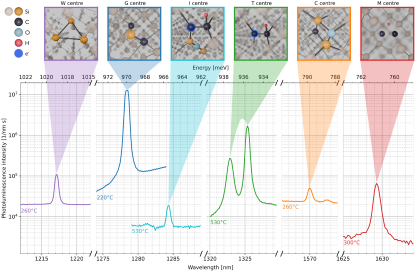
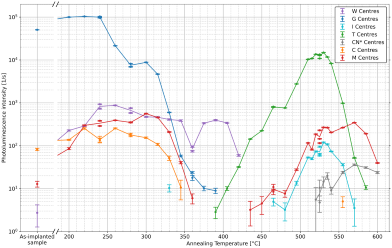
        Colour centres in silicon have great potential as single photon sources for quantum technologies. Some of them, like the T centre, also possess optically-active spins that enable spin-photon interfaces for generating entangled photons and multi-spin registers. We explore the generation of several types of colour centres in silicon for mass-manufacturable silicon-on-insulator quantum devices. We investigate how different processes affect the presence of the quantum emitters, including thermal annealing and fabrication steps for optical nanostructures.
        Characteristic PL spectra of prominent colour centres
        Fig. 1 Characteristic PL spectra of prominent colour centres demonstrating their presence in the 1200 to 1600 nm range after annealing at different temperatures. The commonly accepted atomic structures for the defects associated with each peak are also shown in the insets, though some are controversial and the M centre still has no known structure.
        Photoluminescence signal from 7 optically active colour centres species as a function of the activation annealing temperature.
        Fig. 2 Photoluminescence signal from 7 optically active colour centres species as a function of the activation annealing temperature. The intensity of the signal is extracted as the area of a Gaussian on a second order polynomial background.

        The study reveals coupled formation dynamics between different colour centres, identifies optimal parameters for annealing processes, and reports on the sensitivity to annealing duration and nanofabrication procedures for photonic integrated circuits. These results are compared with previous work on the generation process and future possibilities for alternative generation methods. Furthermore, we discern optical signals stable to processing, which have not been identified before, including a signal in the S-band which corresponds spectrally with a proposed colour centre with applications for quantum technology.

        Speaker: Arnulf Snedker-Nielsen (The Niels Bohr Institute)
    • Company talk: Fabrizio Tamburini (Rotonium) Aula Renzo Leonardi

      Aula Renzo Leonardi

      ECT*

      Strada delle Tabarelle 286, I-38123 Villazzano (Trento)
      • 20
        Room-Temperature Photonic Quantum Computer with Structured-Light Qudits

        We present a room-temperature photonic quantum computing architecture based on structured-light Majorana qudits for hybrid processing from edge to cloud. The method maps finite sectors of the Majorana Tower onto spin-orbital angular momentum photonic modes, realizing a Z2 × Z2-graded encoding of high-dimensional quantum information. The resulting platform supports deterministic two qubit gate logic and scalable integrated photonic hardware without relying on optical nonlinearities. These results identify a route toward compact, low-power photonic quantum processors.

        Speaker: Dr Fabrizio Tamburini (Rotonium s.r.l.)
    • 3:30 PM
      Coffee break Aula Renzo Leonardi

      Aula Renzo Leonardi

      ECT*

      Strada delle Tabarelle 286, I-38123 Villazzano (Trento)
    • Contributed talk Aula Renzo Leonardi

      Aula Renzo Leonardi

      ECT*

      Strada delle Tabarelle 286, I-38123 Villazzano (Trento)
      • 21
        Inequivalence of sets of mutually unbiased bases shapes quantum uncertainty

        Sets of complementary observables with mutually unbiased bases (MUBs) are at the core of quantum uncertainty: Perfect knowledge of one implies maximal indetermination in all the others. This concept is captured by the uncertainty relations, which set a lower bound either on the product or on the sum of the uncertainties of the observables. In both cases, the MUBs yield the largest bound, identifying the condition of maximal uncertainty. Interestingly, for specific dimensions of the Hilbert space and cardinalities of the observable set, sets of mutually unbiased observables can be unitarily inequivalent, i.e. they cannot be mapped into each other by any unitary transformation.
        We show that this constraint directly affects their complementary properties by shaping the pertaining uncertainty relations. This effect unveils an unexpected new property of quantum uncertainty: there are sets of complementary observables such that the choice of mutually unbiased bases identifies distinct uncertainty relations.

        Speaker: Dr Giovanni Chesi (University of Pavia)
      • 22
        Implementing the Quantum Fourier Transform on a molecular qudit with full refocusing and state tomography

        In the NISQ era (Noisy Intermediate-Scale Quantum era), Molecular nanomagnets (MNMs) – molecules containing one or few interacting spins – are emerging as promising building blocks for quantum technologies [1]. Since they naturally provide many accessible low-energy levels, they are particularly suitable to encode qudits, i.e. quantum digits with more than 2 levels, thus enlarging the tools of quantum logic with respect to qubit-based architectures. For instance, MNMs containing single metal ions with a non-zero nuclear spin, strongly coupled to the electronic one by a large hyperfine interaction, can provide a significant number of states for qudit-based algorithms. $^{173}$Yb(trensal) [2] is among the more promising nuclear qudit systems, which can be rapidly and coherently manipulated with radiofrequency (RF) pulses. However, experimental realizations of quantum algorithms on these platforms remain scarce, due to challenges like working with spin ensembles and detecting coherence after long pulse sequences. Here we show the implementation of a Quantum Fourier Transform (QFT), a key algorithm in quantum computation [3], on the hyperfine manifold of $^{173}$Yb(trensal). The QFT operation can be decomposed a in a sequence of Planar Waves Rotations implemented as RF pulses applied to the initial state. Since the experiment was performed on single crystals and thus on an ensemble of nuclear qudits, the RF-pulse sequence crucially includes a custom refocusing scheme, to counteract inhomogeneous broadening, and it ends with a full tomography of the final quantum state, to verify both the resulting populations and coherences. Our results demonstrate the robustness of this procedure: coherences are almost totally refocused, corresponding to a high fidelity in the measured density matrices for different initial states. Future perspectives also include experimental upgrades for the extension of the QFT algorithm to d > 3 levels.
        This work received financial support from the European Union – Next Generation EU Mission 4 Component 1 within the PRIN 2022 program project "CROQUET”- 2022L57S28, CUP D53D23010400006, from the European Union through the Horizon Europe Programme within the ERC-Synergy project CASTLE, proj. n. 10107153 and from PNRR MUR project PE0000023-NQSTI.
        References
        [1] A. Chiesa, P. Santini, E. Garlatti, F. Luis and S. Carretta, Rep. Prog. Phys. 87, 034501 (2024).
        [2] S. Chicco, G. Allodi, A. Chiesa, E. Garlatti, C. D. Buch, P. Santini, R. De Renzi, S. Piligkos, S. Carretta, J. Am. Chem. Soc. 146, 1053–1061 (2024).
        [3] M. Rubín-Osanz, L. Bersani, S. Chicco, G. Allodi, R. De Renzi, A. Mavromagoulos, M. D. Roy, S. Piligkos, E. Garlatti, S. Carretta, Nature Communications (2026), accepted – DOI arXiv:2512.15611 .

        Speaker: Laura Bersani (Dipartimento di Scienze Matematiche, Fisiche e Informatiche, Università di Parma and UdR Parma, INSTM, I-43124 Parma, Italy)
    • Invited speaker: Yun Li (APS) Aula Renzo Leonardi

      Aula Renzo Leonardi

      ECT*

      Strada delle Tabarelle 286, I-38123 Villazzano (Trento)
      • 23
        Meet the editor of Physical Review X – An Editorial View of peer review in PRX and the Physical Review Journals

        In this talk, I will first provide an overview of the Physical Review journals operated by American Physical Society (APS), including their history and current scope. I will focus particularly on Physical Review X (PRX), an online-only, open-access journal that places a high value on innovation, quality, and long-term impact in the science it publishes. Then, I will explain how PRX editors apply these principles in practice, and so determine which few of the many excellent research submissions that we receive make it through to publication. Finally, I will offer some practical tips for authors and referees.

        Speaker: Yun Li (Americal Physical Society)
    • 7:30 PM
      Social dinner
    • Lecture: Robert Raussendorf Aula Renzo Leonardi

      Aula Renzo Leonardi

      ECT*

      Strada delle Tabarelle 286, I-38123 Villazzano (Trento)
    • 10:30 AM
      Coffee break Aula Renzo Leonardi

      Aula Renzo Leonardi

      ECT*

      Strada delle Tabarelle 286, I-38123 Villazzano (Trento)
    • Company talk: Carlos Benavides-Riveros (IQM) Aula Renzo Leonardi

      Aula Renzo Leonardi

      ECT*

      Strada delle Tabarelle 286, I-38123 Villazzano (Trento)
      • 24
        Boosting Imaginary-Time Evolution via Curvature and Higher-Order Statistical Information

        Imaginary-time evolution (ITE) underpins a broad family of algorithms for ground-state preparation, spanning diffusion Monte Carlo, simulated annealing, and quantum imaginary-time evolution. In almost all these methods, convergence is governed by the energy variance of the instantaneous state, a fundamental bottleneck that has remained unaddressed. Here we introduce generalized imaginary-time evolution (GITE), which replaces gradient descent on the energy landscape with a curvature-informed flow that incorporates higher-order statistical information of the instantaneous energy distribution. We prove that GITE strictly outperforms standard ITE at every iteration, and since ITE is a special case of GITE, this acceleration applies simultaneously across the ITE algorithmic family. We demonstrate the performance of GITE on analytically tractable models, the hydrogen chain, and the Fermi-Hubbard model, showing accelerated convergence and substantially fewer iterations to reach a target accuracy.

        Speaker: Carlos Benavides-Riveros (IQM Quantum Computers)
    • Contributed talk Aula Renzo Leonardi

      Aula Renzo Leonardi

      ECT*

      Strada delle Tabarelle 286, I-38123 Villazzano (Trento)
      • 25
        Improving VQE Ground State Accuracy via Soft-Coded Orthogonal Subspace Representations

        In this talk, we present a new approach to improve the accuracy of ground state approximations in Variational Quantum Eigensolver (VQE) algorithms. We employ subspace representations where orthogonality is enforced via "soft-coded" constraints within the cost function, rather than "hard-coded" at the circuit level.

        Similar to other subspace-based methods like Subspace-Search VQE (SSVQE) and Multistate Contracted VQE (MCVQE), our method trains parameters to overlap with the low-energy sector before diagonalizing the Hamiltonian restricted to the subspace. However, by shifting the orthogonality constraints via penalty terms during the minimization, we find that significantly shallower quantum circuits can be used while maintaining high fidelity.

        We validate this approach on two benchmark cases: a 3x3 transverse-field Ising model and random realizations of the Edwards-Anderson spin-glass model on a 4x4 lattice. We show that our soft-coded representation outperforms single-state (standard VQE) and multi-state (SSVQE/MCVQE) approaches, offering a favorable trade-off between circuit depth and accuracy.

        Reference:
        G. Clemente and M. Intini, arXiv:2602.05980 (2026)

        Speaker: Marco Intini (Università di Pisa and INFN)
      • 26
        Connecting Quantum Error Correction and Lattice Gauge Theories

        In this talk I will discuss the connection between quantum error correction and lattice gauge theories, and how it can be exploited to find different models. The redundant degrees of freedom present in lattice gauge theories can be interpreted through the language of quantum error correction, allowing one to remove gauge redundancy while preserving locality. In particular, I will show how $\mathbb{Z}_N$ lattice gauge theories with matter can be naturally described using qudit codes. This perspective simplifies the structure of the theory and reveals dual descriptions between different models, while also highlighting challenges in connecting these ideas to practical quantum implementations.

        Speaker: Luca Spagnoli (University of Trento)
    • 12:30 PM
      Lunch self-organized and free afternoon Aula Renzo Leonardi

      Aula Renzo Leonardi

      ECT*

      Strada delle Tabarelle 286, I-38123 Villazzano (Trento)