
Speaker
Description
Colour centres in silicon have great potential as single photon sources for quantum technologies. Some of them, like the T centre, also possess optically-active spins that enable spin-photon interfaces for generating entangled photons and multi-spin registers. We explore the generation of several types of colour centres in silicon for mass-manufacturable silicon-on-insulator quantum devices. We investigate how different processes affect the presence of the quantum emitters, including thermal annealing and fabrication steps for optical nanostructures.
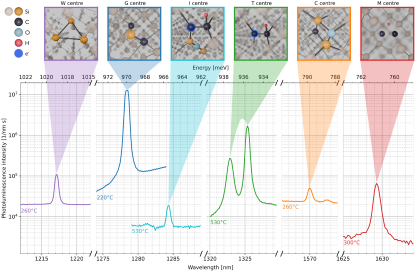
Fig. 1 Characteristic PL spectra of prominent colour centres demonstrating their presence in the 1200 to 1600 nm range after annealing at different temperatures. The commonly accepted atomic structures for the defects associated with each peak are also shown in the insets, though some are controversial and the M centre still has no known structure.
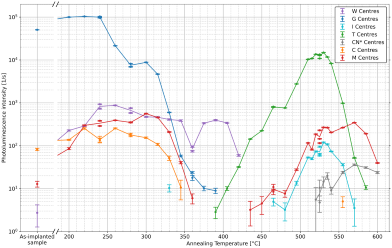
Fig. 2 Photoluminescence signal from 7 optically active colour centres species as a function of the activation annealing temperature. The intensity of the signal is extracted as the area of a Gaussian on a second order polynomial background.
The study reveals coupled formation dynamics between different colour centres, identifies optimal parameters for annealing processes, and reports on the sensitivity to annealing duration and nanofabrication procedures for photonic integrated circuits. These results are compared with previous work on the generation process and future possibilities for alternative generation methods. Furthermore, we discern optical signals stable to processing, which have not been identified before, including a signal in the S-band which corresponds spectrally with a proposed colour centre with applications for quantum technology.